I noticed the man holding a sign before I reached the coffee shop.
It had rained before dawn. Water pooled in the cracks of the pavement, and the plane trees along the curb were shedding the last of their yellow leaves. A delivery truck pulled away with a complaint from its brakes. In the quiet it left behind, I heard a spoon tapping against a cup. A customer sat stirring his coffee inside the gated patio.
As I approached the entrance, the gold lettering on the window caught the morning light.
La Tasse Dorée.
The Gilded Cup.
I hoped that explained the quality of the beverage rather than the prices.
The man with the sign sat beside an outdoor table, beneath the narrow protection of the awning. His brown duck canvas work jacket had faded across the shoulders. Someone had sewn a mismatched patch over one elbow with small, patient stitches. His beard was dark gray. He had broad hands with rough knuckles.
He held a piece of cardboard against his knees and watched the morning traffic over the top.
The sign read:
Anything helps.
Food helps. Coffee helps; money helps way more.
God bless, if you believe in God.
Don’t judge me, and I won’t judge you.
I slowed down enough to read it twice.
Nice lettering. Perfect grammar. A respectable semicolon.
I’d seen professionals do worse with a full keyboard and health insurance. The sign made a simple request and offered reasonable terms. My bank had never managed both on the same sheet.
I nodded. He returned the courtesy.
Then I went inside.
Warmth settled against my face.
I remember the smell most clearly: freshly ground coffee, butter warming in pastry, the faint green bite of rosemary. Beneath it lingered the ordinary smell of a wet entrance mat, which reassured me. Whatever else the place charged, rain still got in for free.
Brass lamps hung over the counter. Small plants occupied the windowsill, their thick, rubbery leaves catching the light. Behind the glass, croissants rested on dark wooden boards beside slices of cake, waiting to be chosen.
The young blonde woman behind the register stood beneath a framed photograph of herself holding a trophy. The plaque below it read Barista of the Year.
I hoped she still took orders from ordinary people.
She watched me approach. Her expression suggested I might be an inconvenience.
I pointed to the photograph on the menu.
“I’ll have that one.”
“The signature latte?”
“And the rosemary scone.”
She tallied the damage.
Eight dollars for the coffee. Nine ninety-nine for the scone. Tax arrived to finish the job.
“Gadzooks. I need a bank loan to pay for this.”
Her expression didn’t change. She turned the payment screen toward me.
I checked the total one last time. I’d really underestimated the “gilded” part.
I selected a generous tip. She glanced at the amount, then past my shoulder.
Behind her, the grinder started with a hard mechanical snarl.
“Name?”
“McBride.”
She typed something.
I decided against checking. A man had to choose his battles. Mine was currently with the total.
While she prepared the order, I looked toward the window.
Outside, the man had drawn his feet beneath his chair to let a woman pass. He lowered his sign so it wouldn’t brush her coat. She carried a handbag that could have supported him through a respectable winter.
He said something.
She kept walking.
“Do you know the fellow outside?” I asked.
The barista followed my glance.
“David.”
“Is he out there often?”
“Every stinkin’ day.”
Steam hissed from the silver wand. She wiped it with a folded cloth.
“He’s disgusting. I don’t know why they let him sit there.”
Her voice had been warmer when she read me the total.
Through the glass, I watched David work a bent corner of his sign flat with his thumb. He pressed it carefully against his knee, checked the result, and tried again.
I kept my observations to myself. She was handling my coffee, and we hadn’t established the terms of immunity.
I watched her pour steamed milk into the espresso, forming a feathery heart.
My order arrived on a small tray.
The scone had split along the top, showing a soft interior beneath its golden crust. Dark needles of rosemary clung to it. A little butter had soaked through the paper underneath.
It smelled good enough to reopen negotiations.
When I looked back at the coffee, the heart had become a face.
At first, I took it for a display of the barista’s considerable ability. Two closed eyes. Rounded cheeks. A small mouth curved into a smile. A brown curl of espresso ran along one side like a lock of hair.
I leaned closer.
One eye opened.
I waited.
Experience had taught me not to react too quickly to these things. Sometimes a man needed sleep. Sometimes his breakfast needed to mind its own business.
The eye regarded me.
“What are you so pleased about?” I asked.
The other eye opened.
“You didn’t pay,” I told it.
The barista glanced over.
“Talking to the coffee,” I explained.
She rolled her eyes and turned away.
I had apparently joined David in a category she preferred not to serve. At least I had a receipt. Whatever else she said about me, I could prove I’d been a customer.
The little face closed its eyes again.
Beyond the window, David shifted in his chair. His sign rested against his legs.
Coffee helps.
I picked up the tray.
The door resisted my shoulder before opening onto a chilly breeze. Water dripped from the awning and ticked against the pavement.
“David. Want a coffee and a scone?”
He looked at the tray, then at me.
“Was it something I wrote?”
“The coffee part.”
“Good. I was worried the semicolon was costing me business.”
I held out the tray.
He didn’t take it.
“Only if you have a coffee with me.”
“I was going to.”
“Standing over me?”
I looked at the empty chair beside his table. A few drops of rain clung to its metal seat.
“I hadn’t worked out the seating.”
“Take your time. Big decision.”
I’d planned to hand over breakfast and make a quiet exit. David had introduced a condition. Apparently, I was being invited to the scene of my own good deed.
I set the tray down.
“McBride.” I offered my hand.
His grip was firm, the skin of his palm rough against mine. He released my hand carefully.
Up close, his eyes were light blue, with deep creases at the corners. His gaze traveled from my hat to the collar of my overcoat.
“You look like Humphrey Bogart’s grandson.”
“His grandson, huh?”
“I’m trying to be polite.”
I considered taking off my hat.
Too late. It had already given a statement.
“I’ll get another coffee.”
“Good idea, Bogart.”
Inside, I ordered a black coffee.
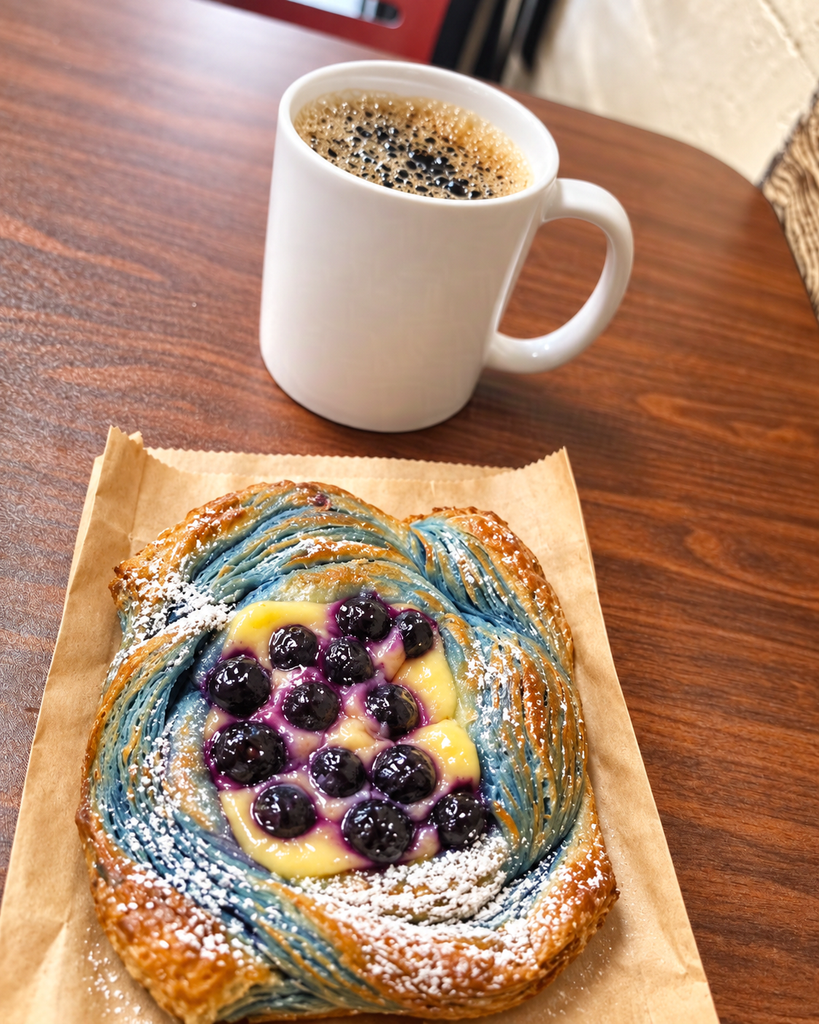
The barista filled a heavy white cup from a steel urn and set it on the counter. A thin brown ripple moved across the surface and settled.
She didn’t ask for my name again.
Either she remembered me or had decided not to encourage a return.
I carried the cup outside before she could offer me a loyalty card. We were both a long way from that kind of commitment.
David had wiped the empty chair with a handful of paper napkins.
He pushed it toward me with his boot.
I eased myself down.
The metal was cold even through my trousers. A bead of water fell from the awning and struck the table beside my hand.
He’d placed the scone between us.
“That’s yours,” I said.
“Didn’t ask.”
He cut it in two with a plastic knife. The crust gave a soft crack, scattering crumbs across the paper. A little steam rose from the middle.
He slid the knife beneath one half and pushed it toward me.
I took it.
For a moment, neither of us spoke. Traffic passed beyond the curb. Inside, the grinder started again, muffled by the window.
I took a sip of the black coffee.
It was hot and strong, its bitter edge mellowing as I swallowed. I felt the warmth move down into my chest.
“Perfect.”
David studied my cup.
“Then why’d you order that thing?”
“I was curious.”
“Expensive condition.”
“I suffer from it.”
“Looks chronic.”
I brushed a crumb from my coat.
The rosemary stayed on my fingers. Butter had warmed the center of the scone, and the crust left a little salt against my lips. Across from me, David held his half over the paper to catch what fell.
“You work around here?” I asked.
“Used to.”
“What happened?”
“The work dried up, and my drinking habit didn’t.”
“And you stayed.”
“For a while, she stayed, too.”
He looked down at the scone.
“The house was never the same after she left. She loved coffee.”
I knew that tone. I’d heard it from men who’d buried their wives and still caught themselves saying “we.” He’d lost her.
I lowered my cup.
He brushed a crumb from his thumb.
“Don’t do that.”
“What?” I asked.
“That face. We were having coffee.”
I hadn’t realized I’d made one.
“Fair enough.”
I picked the cup up again.
David took another bite. A bus stopped at the corner with a sigh of air, hiding the street from us for a moment. When it pulled away, the sunlight had reached the upper windows across the road.
He drew the latte closer.
I’d nearly forgotten about the little face, which told me something about the morning. Usually, an expression in my breakfast retained a certain priority.
I glanced at the foam. The face was gone.
Then I spotted a tiny figure peeking around the far side of the cup. She had a cup-shaped head, a little handle at one side, and bright green eyes.
David turned the cup by its handle.
“You look pleased with yourself,” he said.
I waited for him to look up.
He didn’t.
“You see her?” I asked.
David kept his gaze on the little figure.
“The yokai?”
He adjusted the cup a fraction, as though making someone comfortable.
“Coffee spirit. Yeah, we know each other.”
I remember holding my own cup halfway to my mouth.
The heat pressed against my fingers. Somewhere behind me, a car door shut. I heard those small, ordinary things with unusual clarity while I considered what he’d said.
I’d seen a lot of strange things. Some were harder to explain than others. I’d learned to keep most of them to myself. Talking to my breakfast was one thing; explaining why it answered was another.
David hadn’t hesitated.
He watched her with an ease I’d seen across café tables before, between people who’d long since run out of reasons to impress each other.
I lowered my cup.
“Your wife?”
David nodded, his eyes still on her.
“She always did like the expensive stuff.”
I looked down at my black coffee.
Nothing looked back.
I’d spent years developing the expression a man wore when nothing surprised him. It required a steady gaze, a quiet mouth, and occasional maintenance. David had undone the whole arrangement without leaving his chair.
Across the table, the little spirit closed her eyes, wearing the same pleased smile I’d first seen in the foam.
I studied David over the rim of my cup. The repaired elbow. The carefully lettered sign resting against his chair.
I had walked past him believing I’d noticed quite a lot.
He broke a small piece from the remaining scone.
“Something wrong, Bogart?” David asked.
“No,” I said.
“Then drink your coffee. You’re letting it get cold.”
A breeze moved beneath the awning. He steadied the paper before it could lift, and I set my saucer on the other corner.
There were several questions I might have asked.
For once, somebody else had the answers.
I drank my coffee.